


KAIRU ECO-ART STUDIO
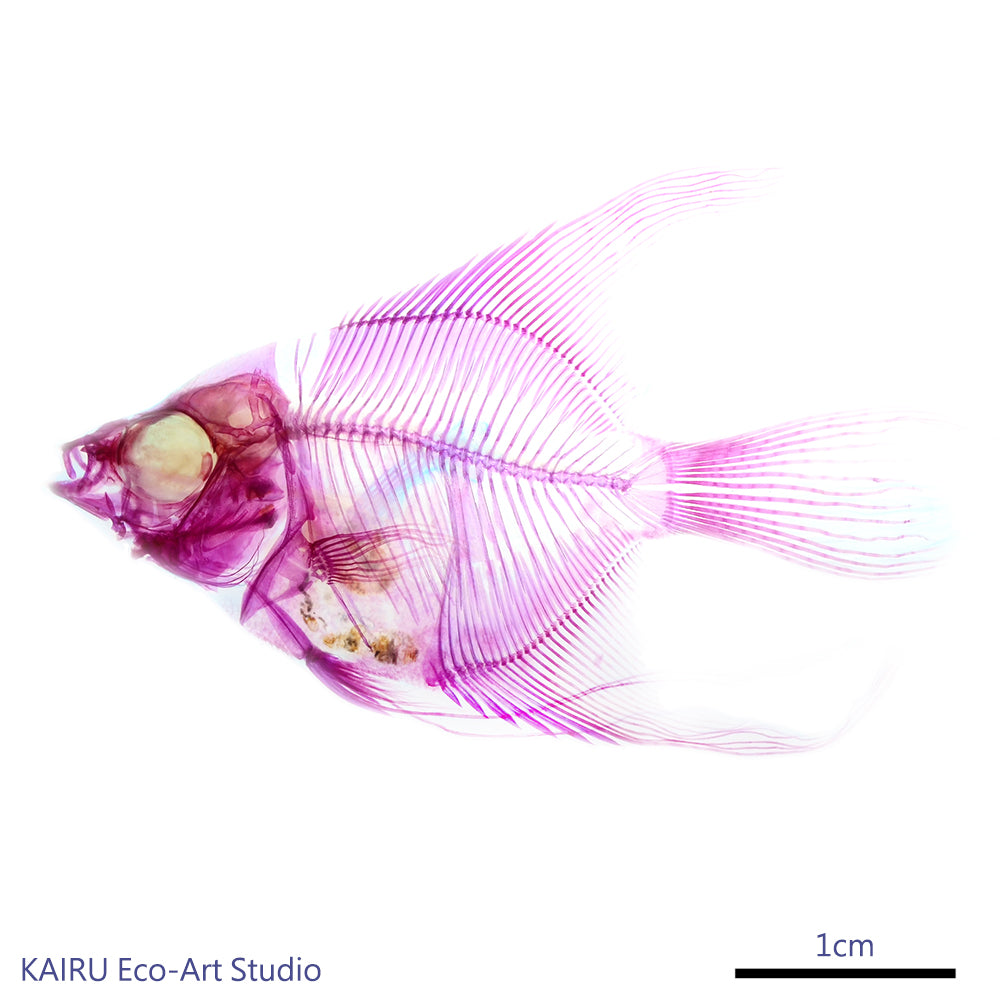
Freshwater Angelfish Pterophyllum sp. Transparent Specimen Series_102_A Miniature Museum on the Table
Freshwater Angelfish Pterophyllum sp. Transparent Specimen Series_102_A Miniature Museum on the Table
Couldn't load pickup availability




Species Encyclopedia
Freshwater angelfish (Pterophyllum sp.) belong to a small group within the Cichlidae family. In terms of appearance, they are laterally compressed into a disc shape, with the dorsal and anal fins gradually lengthening from front to back to create a triangular silhouette, while their pelvic fins are elongated and narrow. Overall, they are highly regarded in the ornamental fish hobby for their beauty and are easily recognizable.
Freshwater angelfish are native to the Amazon River basin in South America, where their unique physique and markings allow them to hide amongst tree roots and river water. They are also ambush predators, primarily feeding on small fish and invertebrates. Due to their temperament, it is important to choose tank mates carefully if keeping them in a community aquarium.
//Product Features//

See With Us, Sea With Us
Kairu Studio handcrafts transparent specimens (Diaphonization) to create your own "miniature museum" on your desk. Each specimen in the glass bottle is a unique collectible; the preserving fluid is safe and non-toxic, allowing the specimen to be kept permanently. Come build your own biological encyclopedia!

How does Kairu turn fish transparent?
Transparent biological specimen preparation is a technique initially used for scientific research. Kairu sources specimens from discarded fish, invasive species, or individuals that have died on farms. Without compromising the integrity of the organism, the remains undergo a multi-stage process involving various chemicals and dyes to transform what would have been lost into stunning, one-of-a-kind transparent specimens.
DIY Kairu’s Marine Lab Series: Transparent Specimen Kit
//Product Specifications//


//Contents//
Transparent biological specimen
High-clarity glass bottle
Glycerin
Display box
Classic species information card
Product warranty card
//Container Dimensions//
15 ml screw-cap glass bottle: 7 cm height, 2.1 cm diameter
60 ml screw-cap glass bottle: 14 cm height, 2.7 cm diameter
Designed by Kairu Studio / Made in Taiwan
//Notes//
> This product is a biological specimen made from deceased organisms, sourced primarily from discarded fisheries or natural deaths.
> For display or educational purposes only; do not consume and avoid excessive handling.
> As these are real biological specimens, photos are for reference only. Slight imperfections (such as incomplete fins) are normal.
> Recommended to be stored in a cool place away from direct sunlight.
> The glycerin preserving solution is non-toxic. If contact occurs, simply rinse with clean water.
> The specimen is stored in glycerin; any air bubbles present can be used to adjust the positioning of the specimen.
> Handcrafted specimens may have slight color variations; photos are for reference only. If you have specific color requirements, please contact us before placing your order.