
KAIRU ECO-ART STUDIO
Clupeidae (Herring) Specimen Transparency Series_029_A Miniature Museum on the Desk
Clupeidae (Herring) Specimen Transparency Series_029_A Miniature Museum on the Desk
Couldn't load pickup availability
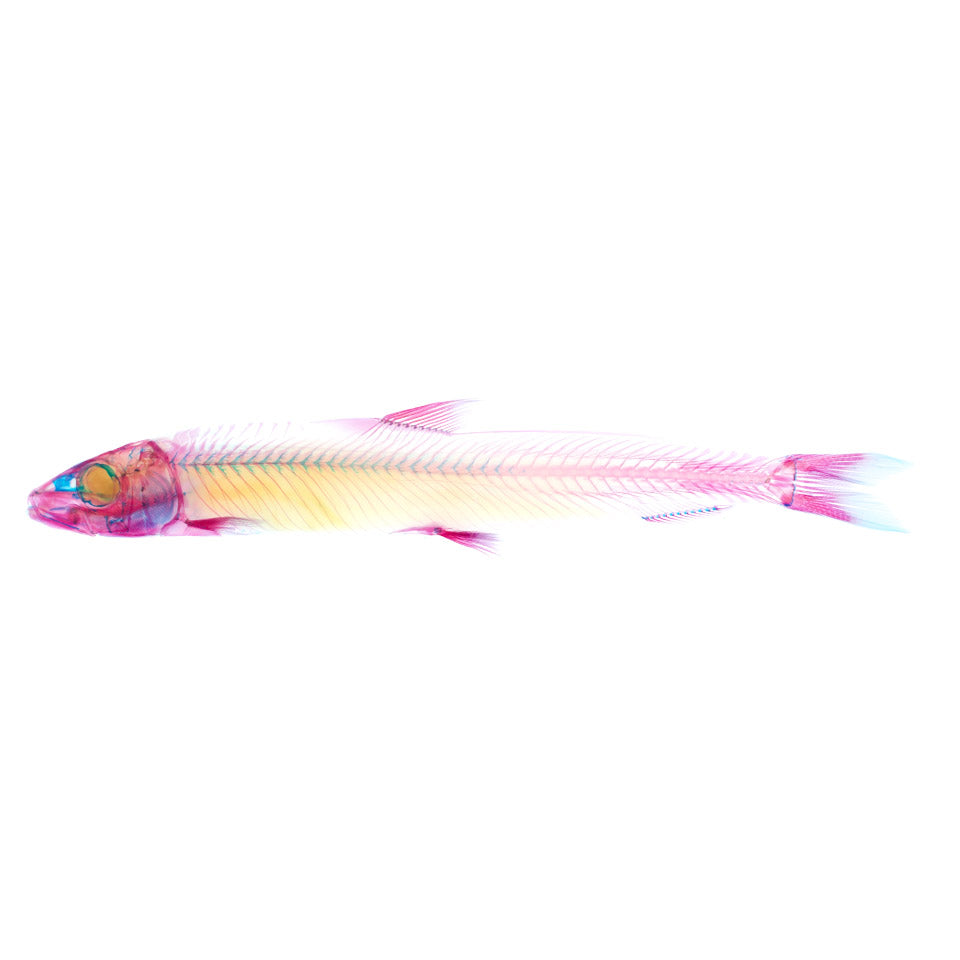
【A Mini Museum on Your Desk】 Diaphonization reveals the unique skeletal structures of organisms. Through staining techniques, red hard bone and blue cartilage become clearly visible. Perfect for desks or bookshelves, these specimens are reclaimed from discarded or naturally deceased organisms, serving as a unique collection that blends scientific education with aesthetic craftsmanship.
//Biological Encyclopedia//
Clupeidae (Herrings)
The family Clupeidae falls under the order Clupeiformes, which also includes the families Engraulidae (anchovies), Dussumieriidae (round herrings), and Chirocentridae (wolf herrings). For preliminary identification: anchovies have downward-facing mouths, while herrings have forward-facing mouths. Herrings have a dorsal fin in the middle of the body, with pelvic fins positioned relative to the dorsal fin; the anal fin base is short with usually fewer than 30 fin rays, and they possess well-developed abdominal scutes. In contrast, anchovy dorsal fins are located between the pelvic and anal fins. In terms of body shape, there is a significant difference between herrings and wolf herrings, with the latter being longer and more laterally compressed. Both herrings and anchovies are filter feeders, whereas wolf herrings are fierce predators.
The Clupeidae family is further divided into 6 subfamilies, which can be distinguished by observing the pelvic fin scale morphology, the presence or absence of a notch in the mouth, the number of supramaxillae, the position of the mouth opening and shape of the lower jaw, and the morphology of the dorsal fin.
Ecological Habits
They have a wide range of habitats, including coastal or near-shore shallow waters such as estuaries, bays, or coral reef areas; some species are freshwater. They are widely distributed across cold, temperate, and warm waters. Most do not exceed 25 cm in length, prefer schooling, and most species produce large quantities of pelagic eggs. Larvae live as plankton and feed primarily on planktonic crustaceans; once they school, their numbers are staggering. A few species are predatory. Many species exhibit diel vertical migration to follow food sources, and they also conduct long-distance migrations for breeding, spawning, or feeding.
Due to their enormous numbers, herrings occupy a vital position in the marine food chain as prey for many organisms. They are economically important in the fishing industry. Most "whitebait" consumed in Asia consists of the larvae and juveniles of this group; however, other fish species are often mixed in during capture, so it is recommended to reduce consumption.
//Product Features//
See With Us, Sea With Us
The Mini Museum on Your Desk series—let’s make the ocean feel a little closer!
Kairu Studio handcrafts these transparent specimens (Diaphonization). As part of the Mini Museum on Your Desk series, every specimen in its glass bottle is a one-of-a-kind collectible. The preservation fluid is safe and non-toxic, allowing for permanent display. Start building your own biological encyclopedia today!
How does Kairu turn fish transparent?
Transparent biological specimen preparation was originally used for scientific research. The specimens Kairu uses are sourced from discarded catch, invasive species, or creatures that have died in breeding facilities. During production, without compromising the integrity of the organism, the remains undergo multiple chemical and staining treatments, transforming an organism that would otherwise be lost into a beautiful, unique, and transparent specimen.
DIY Kairu’s Marine Lab Series: Transparent Specimen Kit
//Product Specifications//
//Contents//
Transparent biological specimen
High-clarity glass bottle
Glycerin
Display box
Classic biological info card
Product warranty card
//Container Dimensions//
15 ml screw-cap glass bottle: 7 cm height, 2.1 cm diameter
60 ml screw-cap glass bottle: 14 cm height, 2.7 cm diameter
Designed by Kairu Studio / Made in Taiwan
//Notes//
> This product is a biological specimen made from deceased organisms, mostly sourced from discarded catch or natural mortality.
> For display or educational purposes only; please do not consume and avoid handling excessively.
> These are real biological specimens; photos are for reference only. Slight imperfections (e.g., incomplete fins) are normal.
> It is recommended to store in a cool place away from direct sunlight.
> The preservation fluid, glycerin, is non-toxic. In case of accidental contact, simply rinse with water.
> The specimens are stored in glycerin; any air bubbles present can be used to adjust the specimen's posture.
> Handcrafted specimens will have color variations. Photos are for reference; if you have specific requirements regarding color, please contact us before placing your order.