
KAIRU ECO-ART STUDIO
Crimson Snapper (Lutjanus erythropterus) Diaphanized Specimen Series_063_Mini Museum on the Desk
Crimson Snapper (Lutjanus erythropterus) Diaphanized Specimen Series_063_Mini Museum on the Desk
Couldn't load pickup availability
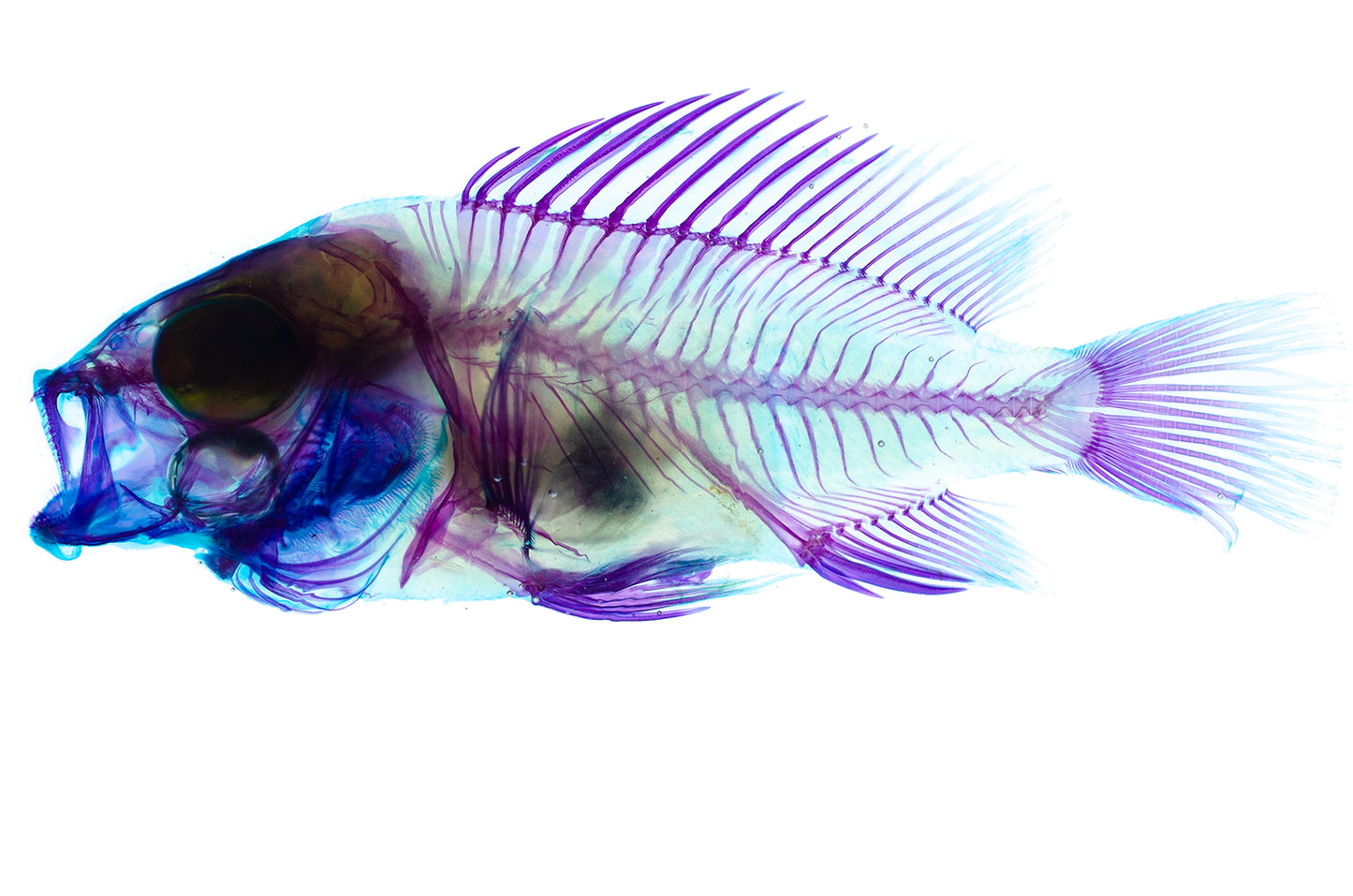
【A Mini Museum on Your Desk】 Transparent specimens reveal the unique skeletal structures of organisms. Through staining techniques, red ossified bone and blue cartilage become clearly visible. Perfect for display on a desk or bookshelf, these specimens are reclaimed from discarded or naturally deceased organisms, making them a unique collection that blends scientific education with aesthetic craftsmanship.
Biological Encyclopedia
Lutjanidae (Snapper family)
The Crimson Snapper, Lutjanus erythropterus, is commonly known in fish markets as the "red fish" or "red chicken" due to the reddish and pinkish hue of adult specimens. During the transparent specimen stage, the following features can be observed: the mouth is relatively small, the notch and protrusion of the operculum are less distinct, the dorsal fin contains 10 spines and 12–14 soft rays. The anal fin also has 3 spines and 8–9 soft rays. The tips of the dorsal and anal fins are rounded. The pectoral fin has 16–17 fin rays. The tail fin is concave. The wild Crimson Snapper is widely distributed throughout the Indo-West Pacific, ranging from as far north as southern Japan to as far south as northern Australia. They inhabit a wide variety of environments, including reefs, sandy areas, and isolated reef structures. Their diet consists of crustaceans, fish, and benthic invertebrates. Currently, the Crimson Snapper can be fully farmed. Due to its rapid growth, it can reach market size within a year. However, as it has high requirements for its environment, it is not considered an easy fish to raise; nonetheless, because of its delicate and delicious meat, it remains a high-value species.
//Product Features//
See With Us, Sea With Us
Kairu Eco-Art handcrafts transparent specimens (Diaphonization) for our "Mini Museum on Your Desk" series. Each specimen inside the glass bottle is a one-of-a-kind collectible. The preservation liquid is safe and non-toxic, and the specimens can be kept permanently. Let’s start building your own biological encyclopedia!
How does Kairu turn fish transparent?
Transparent biological specimens are a type of specimen preparation initially used for scientific research. Kairu sources specimens from discarded catches, invasive species, or organisms that have died in farms. During the production process, without compromising the integrity of the organism, the remains undergo multiple chemical and staining treatments, regenerating them from disappearing remains into exquisite, unique transparent specimens.
DIY Handcraft: Kairu’s Marine Lab Series Transparent Specimen Kit
//Product Specifications//
//Contents//
Transparent biological specimen
High-clarity glass bottle
Glycerin
Display box
Classic biological information card
Product warranty card
//Container Dimensions//
5 ml screw-cap glass bottle: 4 cm high, 2.1 cm diameter
15 ml screw-cap glass bottle: 7 cm high, 2.1 cm diameter
60 ml screw-cap glass bottle: 14 cm high, 2.7 cm diameter
Designed by Kairu Eco-Art / Made in Taiwan
//Notes//
> This product is a biological specimen made from deceased organisms; sources are primarily discarded fishing catches or naturally deceased creatures.
> For decorative or educational use only; please do not consume or handle excessively.
> These are real biological specimens. Photos are for reference only; minor imperfections (such as slightly incomplete fins) are normal.
> Recommended for storage in a cool place away from direct sunlight.
> The preservation liquid, glycerin, is non-toxic. In case of contact, simply rinse with water.
> Specimens are stored in glycerin; any air bubbles present can be used to adjust the pose of the specimen.
> All handmade specimens will have slight color variations. Photos are for reference; if you have specific color requirements, please contact us before placing your order.